Content Design · 2024
Legálitas Negocios
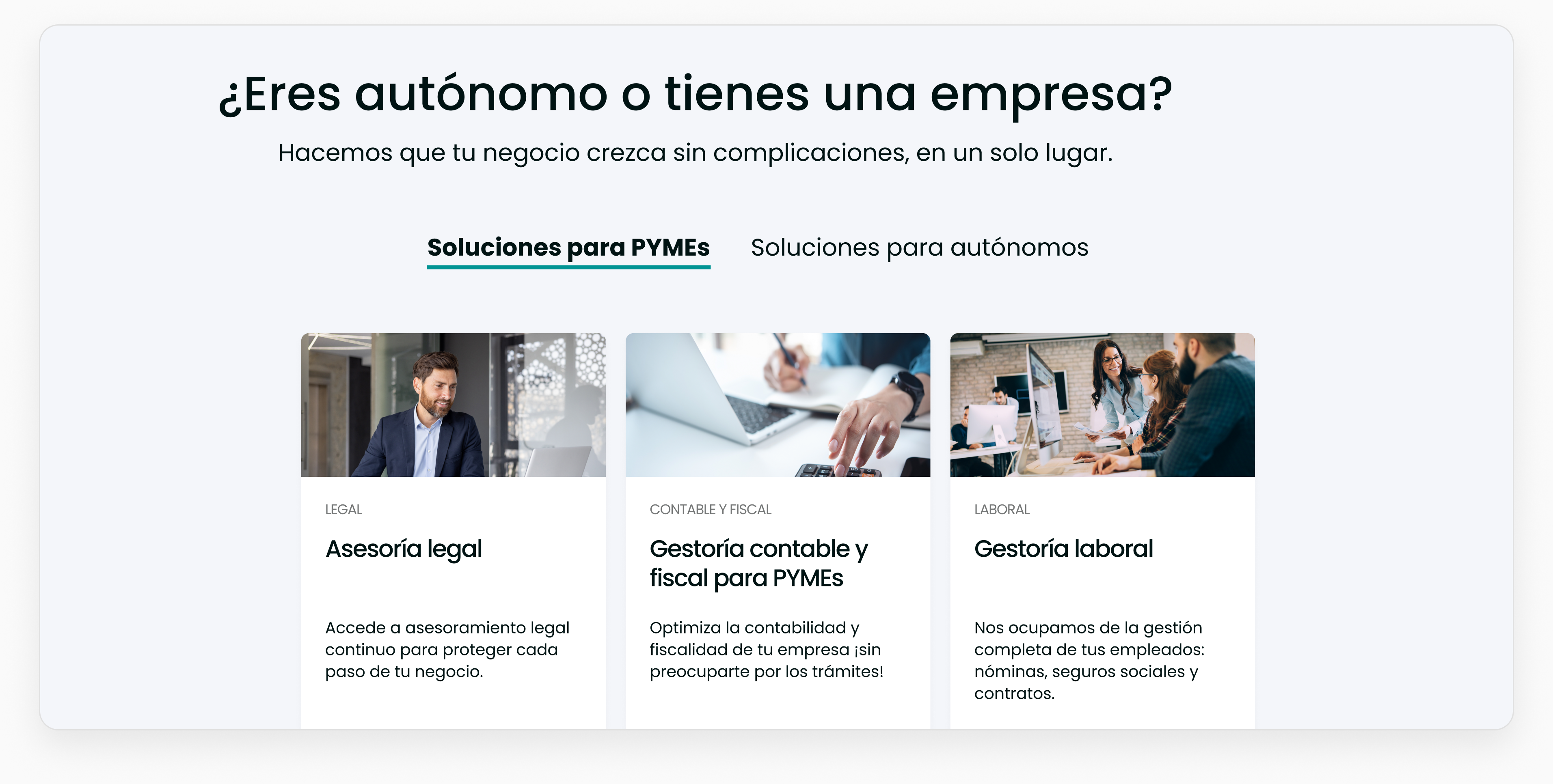
Content and information-architecture redesign of Legálitas's business/freelancer section: making a services catalog written in dense, technical language legible and comparable for users who didn't understand it.
Legálitas Business — content design
From the language nobody understood to one that lands
Provision of legal assistance by phone and in person in the field of commercial, labor and administrative law, including the handling of proceedings and the drafting of contractual documentation, subject to the limits and exclusions set out in the general terms and conditions.
Technical, dense register. The user can't tell what they're buying or compare it.
A lawyer helps you by phone or in person with whatever your business needs: contracts, claims, employment matters or dealings with the authorities. And we explain what's covered and what isn't, no fine print.
Everyday language, focused on what the service solves. Clear without losing precision.
B2B product · Content design · Information architecture · ~3 months
Context
I worked as the lead product designer on the redesign, with occasional support from a couple of colleagues, but I drove the project. The starting point wasn't zero: an Interbrand report had already defined a positioning and a brand-language shift for marketing, and I built the product and content side from there.
The scope was the entire public products-and-services section for businesses and freelancers on Legálitas: from the SMB/freelancer home to the individual product pages. The end users were freelancers and manager-type profiles hiring services for their business —people with no legal training who need to understand what they're buying.
The legal domain here is the context of difficulty, not the subject: the discipline of this case is content design and information architecture in a dense, regulated domain — a muscle that transfers to banking, healthcare, or any technical product.
Client: Legálitas. Duration: ~3 months.
What I did
The section's architecture, reorganizing the content, and —above all— how the products were explained and told.
What others brought
Interbrand supplied the positioning framework and brand language; a couple of colleagues gave occasional support.
The Problem
The content didn't land. People didn't know what each service actually was: there was a lot of text that said nothing, and language too technical for anyone who isn't a lawyer.
On top of that, the information was organized around the business's internal logic —how Legálitas grouped its services— not around the real needs of whoever landed on the site. And since hiring ultimately closed over a phone call, the website mainly had to work as a decision-making tool: if a freelancer can't understand what a service is or compare it to another, the website isn't helping them decide. That was the real failure, and it wasn't visual — it was comprehension.
Legálitas Business — information architecture
Before by internal categories, after by “who I am and what I need”
Before · internal taxonomy
Legálitas catalog
- Tax area
- Labor area
- Commercial area
- Administrative area
Organized around how the business groups its services, over the real needs of whoever lands on it.
After · entry by profile
Freelancer
“What do I need for my case?”
- Service, explained
- Service, explained
- Service, explained
Company
“What do I need for my case?”
- Service, explained
- Service, explained
- Service, explained
Entrepreneur
“What do I need for my case?”
- Service, explained
- Service, explained
- Service, explained
Structured by profile and need. The user thinks “I’m a freelancer, what do I need?”, not in product families.
Process
Decoding the density. The raw material was huge, very dense legal documents, and access to the experts who could explain them was limited and infrequent. I leaned on AI to decode and summarize that documentation, bringing the density down to something understandable without depending on availability I didn't have. AI removed the friction of untangling the material; the judgment on what was correct and what was clear stayed mine.
Reorganizing around the user, not the catalog. I restructured the section around real profiles and needs —freelancer, business, entrepreneur— instead of the internal taxonomy the business used to group its services.
Translating the language. I rewrote how the products were described, moving from a technical register to user-facing language oriented around what the service actually solves. I used AI to shuffle through different copy proposals aimed at the end user, and chose between them.
Validating by negotiating. There was no formal user test; validation happened with the business side, and it cost something. Bringing the technical register down to user language grated on them, and there was considerable negotiation involved, but they came around to seeing it was necessary.
Legálitas Business — method
AI to decode the density and shuffle wordings; the judgment, mine
Dense legal documentation
Huge legal documents. Access to the experts was limited and infrequent.
AI · decode and summarize
Bring the density down to an understandable summary and structure, without depending on availability I did not have.
AI · shuffle wordings
Explore several copy proposals aimed at the end user, and choose between them.
AI removes the friction of untangling and shuffling. What is correct and what is clear is my call, and every rewording is checked with the business before it ships.
Key Decisions
Organize by the user's need, not the catalog's internal logic
I structured the section by profile and need (freelancer, business, entrepreneur) instead of by how the business grouped its services. Trade-off: breaking with the internal taxonomy forces a full remap and pushes the business out of its comfort zone; respecting their categories would have been easier and less contentious. I did it because the user doesn't think in product families: they think "I'm a freelancer, what do I need?"
Bringing the technical register down to user language (the central negotiation)
I rewrote the content in everyday, benefit-oriented language, instead of the technical, formal register Legálitas used to describe its services. Trade-off: the tension wasn't about legal accuracy —plain language didn't make anything legally incorrect— it was about brand register: it was the form the institution was used to, and dialing it down felt to them like losing seriousness. The cost was considerable time and negotiation to argue that clarity isn't the opposite of rigor. The result: language the user understands without the service becoming any less precise.
Leaning on AI for the legal density, without delegating judgment to it
I used AI to decode and summarize very dense legal documentation, given limited access to the experts. Trade-off: AI could oversimplify or drop legal nuance, risking inaccuracies. I managed that by using it to understand and explore, never as a final source: every rewording was checked against the business before publishing.